
Prose Before Plot
NYT Bestseller Eric Puchner on the one skill you need to get published

Welcome back to Book Stack, the interview series where authors break down their deepest craft obsessions. Today, we’re chatting with New York Times bestselling author, Eric Puchner. His latest novel, Dream State1, was a 2025 Oprah’s Book Club Pick and one of my favorite reads from last year. I first met Eric when I was a student at Johns Hopkins University. I went into his short story craft course pretty set on becoming a commercial horror writer and emerged from the class with a deep love for literary fiction. While in his class, I started writing short stories about Jo, a white girl who was raised by a Black family. After turning in six of these stories, he pulled me aside and said, “Kat, I think you have a novel with your character, Jo.” Now, eleven years later, I can proudly say he was right; my debut novel, Good People, is forthcoming from Simon & Schuster.
Needless to say, Eric has been one of the most influential teachers in my writing life. Today, I’m so excited to share his Book Stack and how these books will change your approach to line-level writing.
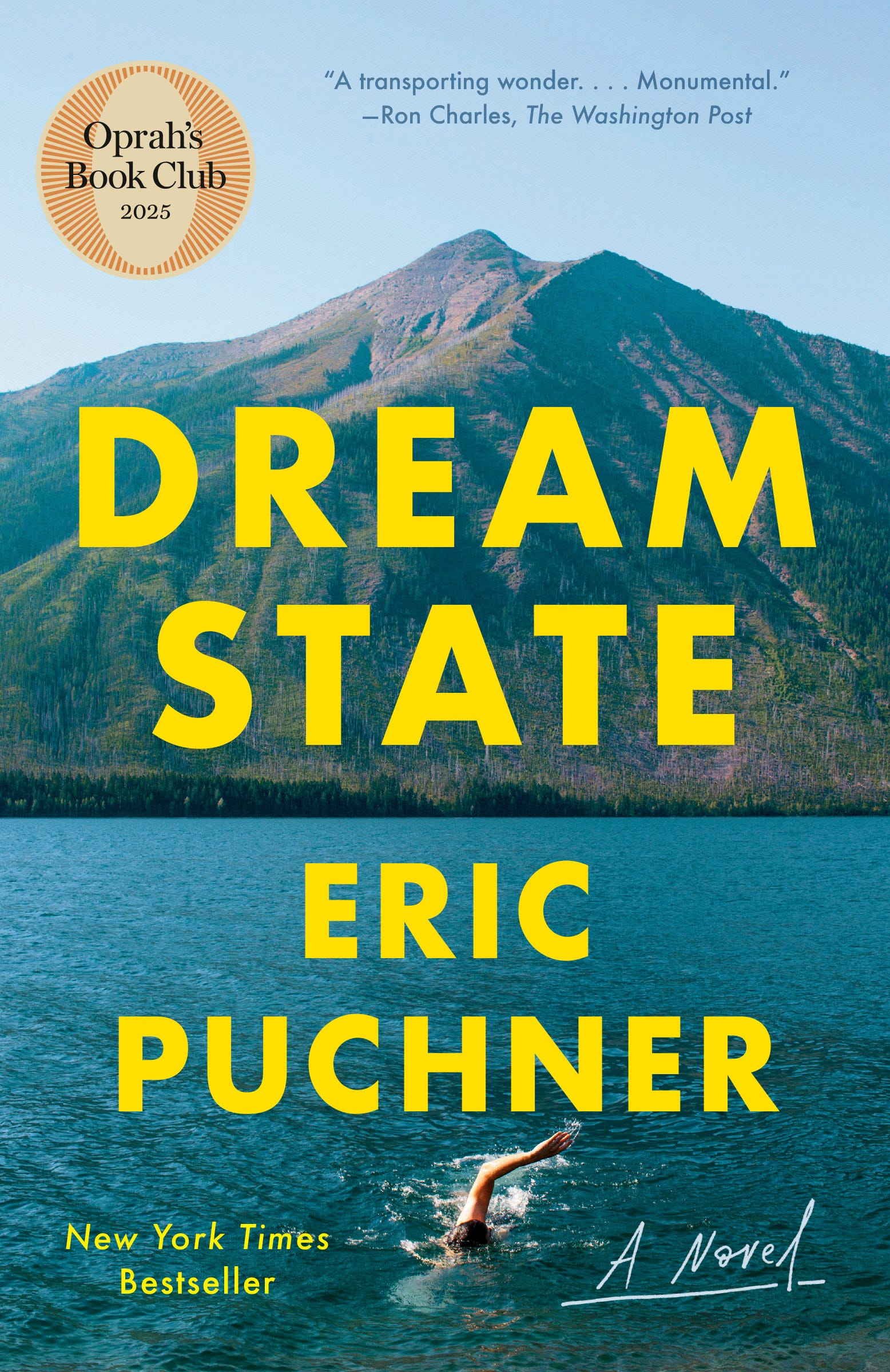
1. Most writers have a craft concept that they’ve struggled with and obsessively studied. In your experience, what craft concept do you believe writers should master before seeking traditional publication?
For me, by far the most vital work happens on the sentence level. If your sentences aren’t clear and precise and vivid and alive, if they don’t have integrity, then your story or novel has no hope of being these things either. I often tell my students to slow down and craft the best sentences they can; this means being ruthless when it comes to extraneous words and needless abstraction. A good sentence is concrete and unassailable; you should be able to shake it without anything falling out. If you can say something more simply and directly than the way you’ve said it, in fewer words, then chances are your sentence hasn’t reached its final form.
2. If you were curating an essential “Book Stack” of three books that perfectly exemplify precise line-to-line writing, what three titles would you pull from your bookshelf?
I’d probably start with Isaac Babel’s Red Cavalry, just to start with a master of the perfect, and perfectly uncluttered, sentence. He was an obsessive stylist who rewrote his sentences many times over, whittling them down to their essence. And he said my two favorite things about the importance of getting every word and bit of punctuation right: “Only a genius can afford two adjectives per noun” and “No iron spike can pierce a human heart as icily as a period in the right place.”
Then I’d throw in The Visiting Privilege by Joy Williams, which is her collected stories, to show how a sentence can be ruthlessly spare, honed to absolute perfection, but also wildly original at the same time. There isn’t a sentence in her body of work that feels tired or familiar. She’s not someone who confuses wordiness with “beautiful” writing.
And finally, Edward P. Jones’ Lost in the City, because he’s so good at conveying emotion without ever veering into abstraction. He’s a master of restraint; like Chekhov, he knows that a single, perfectly rendered detail—or action—is often more moving than directly explaining what someone is feeling.
3. How did you approach line-to-line writing in Dream State?
It took me seven years to write Dream State, and I worked on it nearly every day. That should tell you everything you need to know about how many times I rewrote every sentence.
4. Once a writer feels they have successfully integrated good sentences into their manuscript, what is the single most important step they should take before sending their book to agents or editors?
Reread and rewrite! The fiction writers I went to grad school with who ended up publishing books weren’t necessarily the most talented; they were the ones who understood the importance of revision, who were willing to send their stories or novels through twenty-five drafts. Read your sentences aloud to yourself, many times over, and be merciless with them.
Eric Puchner is the author of the story collection Music Through the Floor, a finalist for the New York Public Library’s Young Lions Fiction Award; the novel Model Home, which was a finalist for the PEN/Faulkner Award in Fiction; and a second short story collection, Last Day on Earth. His short stories and personal essays have appeared in GQ, Granta, Tin House, Best American Short Stories, and more. He has received an Award in Literature from the American Academy of Arts and Letters. He is an associate professor in the Writing Seminars at Johns Hopkins University and lives in Baltimore with his wife, the novelist Katharine Noel, and their two children.
Where to Find Eric:

Where in your writing process does prose become a priority? Do you edit your lines as you write your draft? Or do you focus on your line-to-line writing more in revision?
Let’s talk all things prose in the comments:
Until next time,
Kat
This post includes affiliate links. I may receive a commission if you make a purchase through these links. Purchasing books through the Craft with Kat Bookshop supports the free writing resources I share here on Substack.
What a fabulous interview! I'm heartened to hear Puchner's perspective on the sentence--I often fear I focus TOO much on sentences and style, but I really believe they're the foundation of all great writing. I'll absolutely check out Dream State now, as well as his recommendations!
This is so great! Makes me envious of folks who can write a stellar sentance AND weave a thrilling story.